

General information
Coast Seafood recognizes the crucial role we play in fostering a more sustainable future. Our value chain impacts people, the environment and society at large.
In this sustainability report, Coast Seafood presents its continued efforts to advance the transition toward a fair and low emission society, as well as its approach
to identifying, assessing, and managing sustainability related risks and opportunities with potential implications for the company’s operations, strategic priorities, and long term value creation.
The regulatory environment for sustainability reporting remains subject to ongoing development, and future requirements may evolve further. Notwithstanding this uncertainty, Coast Seafood is committed to maintaining a high standard of transparency and accountability in its disclosures, guided by recognized and authoritative reporting frameworks.
For the 2025 report, we continue to base our methodologies and overall structure on the ESRS framework. While the report does not yet meet all detailed ESRS requirements, it provides a recognizable and transparent account of our ESG status and progress. In the year ahead, we will place particular focus on strengthening data quality and improving the completeness of our information, enabling more robust and transparent reporting going forward.
General
information
Basis for preparation
GENERAL BASIS FOR PREPARATION (BP1)
The Sustainability Report for Coast Seafood Group provides a comprehensive and consolidated over- view of the Group’s operations, encompassing all relevant subsidiaries and affiliated entities.
All operational sites including production facilities, administrative offices, and logistics centres form an integral part of our value creation process.
By including these locations within the reporting scope, we ensure consistent adherence to the Group’s standards for quality, operational excellence, and continuous improvement across the full production cycle.
The report spans the entire value chain of Coast Seafood Group and outlines our sustainability practices across the following key stages:
Sourcing: Responsible procurement of raw materials, with a focus on ethical business practices and the safeguarding of natural resources.
Processing: Deployment of energy-efficient and environmentally responsible production technologies and methods.
Logistics: Optimization of transportation and distribution to minimize carbon footprint.
Coast Seafood in the World
– A global seafood company
with its heart in Måløy
Our commitment to people, planet and performance shapes how we work, grow and deliver every day.
Sverre Søraa
CEO Coast Seafood
Strategy and business model
Founded in 1994, Coast Seafood is a Norwegian seafood group specializing in creating value between fish farmers and end-consumer through our leading expertise in processing, marketing, sales and logistics. In this chapter, we present our global reach and market presence, as well as our strategy and business model.
Coast Seafood takes great pride in offering a diverse range of high-quality seafood products worldwide. Our global operations and strategic locations around the world, have given us a comprehensive understanding of all seafood markets, enabling us to constantly expand our reach and develop new markets.
Value Chain
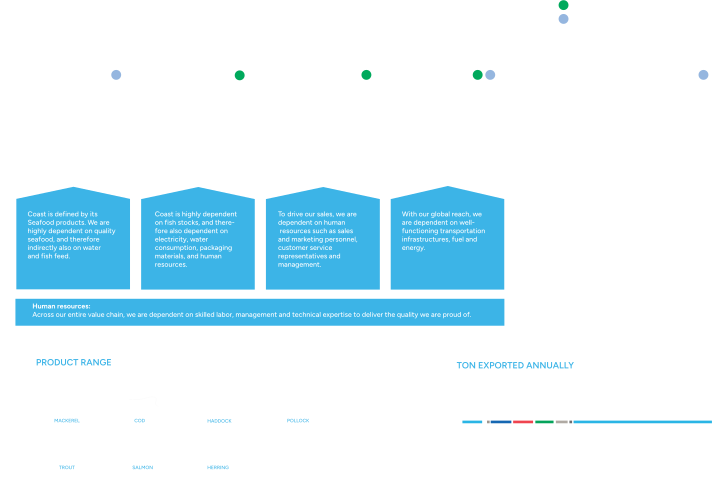
Coast Seafood is involved in every stage of the value chain. Our primary focus is on maximizing value creation between fish farmers and end-consumers.
We achieve this through our dedicated efforts in processing, marketing, logistics and sales.
Metrics
METRICS IN RELATION TO MATERIAL SUSTAINABILITY MATTERS (MDR-M)
To advance sustainability efforts, Coast Seafood is working on establishing clear targets and metrics. Setting quantifiable targets provides a clear roadmap for progress and ensures accountability for our actions.
As we look ahead, our top priority will be to enhance the quality of data across all dimensions.
COAST SEAFOOD COMMITS TO THE FOLLOWING:
Environmental
Information
Climate Change
MATERIAL IMPACTS, RISKS AND OPPORTUNITIES AND THEIR INTERACTION WITH STRATEGY AND BUSINESS MODEL (SMB-3)
Climate change is broadly acknowledged as one of the most significant global challenges of our time. Driven primarily by human activities, it has resulted in rising sea levels, ocean acidification, and a range of other profound changes to marine ecosystems.
As these developments continue to intensify, they pose substantial risks to seafood production and to the communities and industries whose livelihoods depend on healthy and stable ocean environments.
As a global seafood group, Coast Seafood acknowledges its responsibility to actively mitigate its environmental impact and contribute to the preservation of natural resources that underpin the industry. While seafood generally has a lower carbon footprint compared to other sources of animal protein, the company remains committed to continuous improvement and to supporting the achievement of the Paris Agreement.
Coast Seafood is committed to promoting responsible stewardship of the oceans and coastal ecosystems we rely on. As we work to improve the quality of our emissions data to better understand our carbon footprint and identify areas for improvement, we are also exploring and investing in innovative solutions to reduce emissions within our operations and throughout our value chain.
Water and marine resources
The health of the oceans is fundamentally linked to the quality and freshness of seafood. Protecting marine environments and ensuring their resilience through sustainable practices is essential not only for the present but also for the future of seafood production. Norwegian seafood is renowned globally for its exceptional quality, freshness, and taste. Good fish health through sustainable fish farming and clean oceans are therefore fundamental prerequisite in our business model.
DESCRIPTION OF THE PROCESS TO IDENTIFY AND ASSESS WATER AND MARINE RESOURCES-RELATED IMPACTS,
RISKS AND OPPORTUNITIES (IRO-1)
Coast Seafood Group identifies water and marine resources as one of our key focus areas. The process for identifying and assessing impacts, risks, and opportunities related to this topic is guided by the dual materiality principle outlined in ESRS, as it is for all our material topics.
Resource use & Circular Economy
The world’s natural resources are under increased pressure. The global use of resources is closely linked to negative ripple effects such as greenhouse gas emissions, climate change, loss of biological diversity, waste and pollution. At Coast Seafood, we recognize the importance of resource efficiency and waste management in protecting our natural capital. Utilization of raw materials is our most important initiative, as it plays a crucial role in mitigating these negative impacts and ensuring sustainable practices.
DESCRIPTION OF THE PROCESS TO IDENTIFY AND ASSESS MATERIAL RESOURCE USE AND CIRCULAR ECONOMY-RELATED IMPACTS, RISKS AND OPPORTUNITIES (IRO-1)
Our process for identifying and assessing material impacts, risks, and opportunities related to resource use and circular economy is guided by the dual materiality principle. This framework is outlined in the European Sustainability Reporting Standards (ESRS).
The approach is both comprehensive and data driven. Extensive data is collected on resource inflows, outflows, and waste from all operational sites. This data is carefully analyzed to identify areas of high risk. It also highlights potential impacts on resource use and waste management.
Own workforce
MATERIAL IMPACTS, RISKS AND OPPORTUNITIES RELATED TO OWN WORKFORCE AND THEIR INTERACTION WITH STRATEGY AND BUSINESS MODEL (SMB-3)
The most important resource in the Coast Group is our people. All employees play a crucial role in achieving our short and long-term goals. As a responsible business, we are committed to upholding labour standards, respecting human rights, and promoting non-discrimination within our workplace. Our aim is to foster an environment where our employees can thrive and reach their full potential.
Our employees are fundamental to Coast Seafood Group’s success and long term performance. Their competence, commitment, and contributions are essential to the Group’s ability to achieve its strategic objectives. Coast Seafood is committed to conducting business responsibly, with labour standards, respect for human rights, and equal treatment forming core principles of its operations.
Through its work under the Transparency Act, as further described on coast.no, Coast Seafood has committed to acting responsibly and to respecting fundamental human and labour rights. This commitment is formalized through the Group’s Human Rights Policy and Supplier Code of Conduct, which set clear expectations for both internal operations and the wider value chain.
Consumers and end-users
MATERIAL IMPACTS, RISKS AND OPPORTUNITIES RELATED TO CONSUMERS AND END-USERS AND THEIR INTERACTION WITH STRATEGY AND BUSINESS MODEL (SMB-3)
Healthy foods – Why it matters
Delivering high-quality seafood goes hand in hand with sustainable seafood practices. Ensuring quality encompasses key aspects such as food security, tracing, fish welfare, and sustainable production. Coast Seafood provides 1,200,000 healthy meals daily and adheres to the strictest food security standards.
Seafood is widely recognised for its high nutritional value, providing essential omega 3 fatty acids, vitamins, and minerals, and is generally regarded as a resource efficient source of animal protein. Coast Seafood Group takes pride in its role within the seafood value chain and in contributing to the development of sustainable food systems.
We acknowledge that our activities carry inherent risks and responsibilities, and that inadequate practices or controls may result in adverse impacts on consumers and other stakeholders. To mitigate these risks, Coast Seafood Group has established comprehensive food safety management systems, supported by documented procedures, monitoring protocols, and control measures. These frameworks are designed to ensure compliance with applicable regulatory requirements, safeguard product integrity, and uphold high standards of quality, safety, and responsible business conduct throughout our operations.
TAKING ACTION ON MATERIAL IMPACTS ON CONSUMERS AND END- USERS (S4-4)
Managing our impacts
By adhering to stringent food safety measures, implementing robust traceability systems, and obtaining relevant certifications, Coast Seafood strives to manage our impact on consumers effectively. We aim to provide our customers with seafood that not only meets the highest quality and safety standards but also aligns with their expectations for sustainability and responsible sourcing.
Food safety
We rigorously monitor and analyse microbiological results to ensure they remain below the limits set by the European and Norwegian Food Safety Authorities. Additionally, all our suppliers are approved by the Norwegian Food Safety Authority for their specific activities in food production and undergo regular audits
Fish Welfare
The quality of the Group’s products is closely linked to fish health and welfare at the farm level, including practices related to handling, feeding, and the treatment of illness. Coast Seafood Group sources seafood from suppliers that are often smaller, local fish farmers, many of whom demonstrate a strong focus on fish welfare.
Governance
Governance – why it matters
Strong governance is a fundamental pillar of a well functioning organization. As a global seafood exporter, Coast Seafood is committed to the responsible, effective, and ethical management of its resources, operations, and stakeholder relationships. Sound governance practices are essential to ensuring transparency and accountability in decision making, promoting fairness and inclusivity, and ensuring compliance with applicable ethical and legal requirements.
THE ROLE OF THE ADMINISTRATIVE, MANAGEMENT AND SUPERVISORY BODIES (GOV-1)
Coast Seafood Group has established a robust governance framework to ensure effective decision making and support the Group’s long term, sustainable value creation. The governance structure is designed to provide clear roles and responsibilities, strong oversight, and effective integration of sustainability considerations into strategic and operational decision making.
ESG policy
Purpose
As part of delivering world class seafood, we aim to contribute to sustainable practices across environmental, social and governance (ESG) aspects within our industry.
Coast Seafood is committed to long-term sustainable and responsible development, which entails conducting our activities in compliance with applicable law and in alignment with recognised industry standards and best practices.
The purpose of this ESG Policy is to outline the principles for Coast Seafood’s approach to matters concerning environment, social and governance. We seek to integrate ESG matters into our daily operations, including our processing of seafood, by assessing and taking account of risks, impacts of decisions, and opportunities to adopt ESG for long term value creation.
Our efforts to identify, integrate and improve on our material ESG matters are continuous, while we recognize that responsible and sustainable development may entail certain dilemmas and complexities.
We conduct our business with a high standard of ethical and responsible behaviour. To uphold high environmental, social and governance standards to our shareholders, and the community, we have adopted this ESG policy.
Social
information